Support Coordination is Changing: What NDIS Participants Need to Know About the New SCC Reform
Published: 17 September 2026
Big changes are coming to Support Coordination within the NDIS.
The Australian Government has announced that from 1 July 2028, the way Support Coordination is delivered will change. A new Support Coordination and Connection (SCC) service will replace the current model. Importantly, the final design of the new service has not yet been decided.
The Department of Health, Disability and Ageing and the NDIA are currently consulting with people with disability, families, carers, providers, advocates and the broader disability community about how the new model should work. Consultation is open until 2 October 2026.
At Rosie Disability Services, we want our participants and families to understand what is being proposed and, most importantly, know that you can have your say.
What is actually changing?
Currently, participants who have Support Coordination included in their NDIS plan receive funding within their plan and can choose a Support Coordination provider. Under the proposed future model, participants would no longer receive Support Coordination funding within their individual NDIS plan. Instead, the NDIA would directly fund and contract organisations to provide Support Coordination and Connection services within defined geographical areas. This means there would be fewer organisations approved to provide Support Coordination than there are today.
The Government's consultation paper acknowledges that this may mean some participants will experience a change in who supports them if their current Support Coordinator is not part of the future SCC organisation operating in their area.
In simple terms:
Today: Your NDIS plan can include Support Coordination funding → you choose a Support Coordination provider → that provider claims against your plan.
From 1 July 2028: If you are eligible for SCC → the NDIA funds the SCC service directly → you access an approved SCC provider operating within the new commissioned system.
The Government's current public information says participants will choose from providers funded directly to deliver these services, while the consultation paper also makes clear that there would be fewer approved providers and that the precise commissioning arrangements are still being considered.
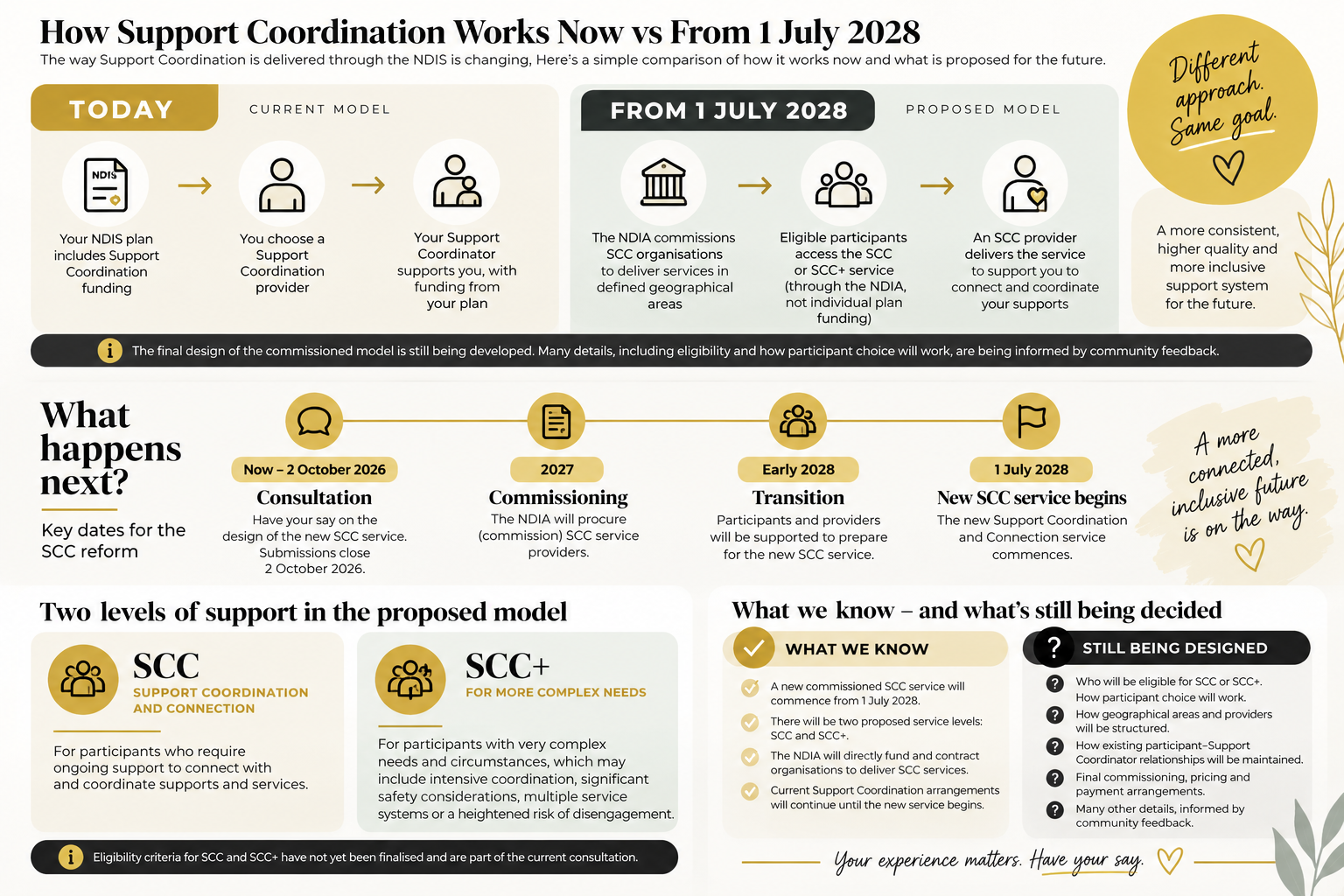
What is "commissioning"?
Commissioning is different from the open provider market we currently have. The Government defines commissioning as the process of planning, funding, procuring and overseeing services to meet identified needs and outcomes. This includes selecting providers and monitoring their performance. Under the new system, the NDIA would directly contract organisations to provide SCC services.
Two possible approaches are currently being considered:
a lead organisation model, where one organisation would be responsible for providing and/or coordinating SCC services across an entire region; or
a multi-provider model, where multiple providers could pool their resources and expertise across or within regions.
The consultation paper states that the NDIA's current preferred model is a lead organisation model, with one organisation per region responsible for providing and/or contracting the SCC services required across that region. However, this remains part of the proposed design being consulted on.
There would be two levels of support
The proposed model would replace the existing Support Coordination structure with two levels:
SCC – Support Coordination and Connection: For participants who require ongoing assistance to connect with and coordinate supports and services.
SCC+: For participants with very complex circumstances, which could include intensive coordination needs, significant safety considerations, complex support environments, involvement with multiple service systems or a heightened risk of disengagement. The Government says SCC+ would be available to a relatively small proportion of NDIS participants and would likely involve greater contact and specialist workforce skills.
The eligibility criteria have not yet been finalised.
The consultation paper does, however, identify factors that could be considered when determining eligibility, including decision-making capacity, safety risks, the stability of formal and informal supports, the predictability of support needs, understanding of the NDIS and other systems, involvement with multiple systems and risk of disengagement.
What would an SCC worker actually do?
There is a lot about the proposed role that will sound familiar to people who currently work with a Support Coordinator. The new service is being designed around three broad functions: Collaboration, Connection and Coordination.
SCC workers could help participants:
connect with appropriate supports and services
coordinate services
make informed decisions
understand and implement their NDIS plans
develop their confidence navigating services
identify emerging risks
manage transitions between services
strengthen their support networks
remain connected with their community and other services.
However, SCC workers would not make decisions on behalf of participants, replace supported decision-making arrangements, provide advocacy, determine NDIS eligibility, manage participant finances, provide crisis response services or replace the responsibilities of mainstream systems such as health, housing, justice and education.
Why is the Government making this change?
The Government says the reform is intended to address issues it has identified within the current Support Coordination market, including inconsistent service quality, conflicts of interest, variable workforce capability, access difficulties in thin markets, inconsistent oversight and concerns with the current fee-for-service model.
At the same time, the consultation paper acknowledges that many participants report positive experiences with Support Coordination and value the expertise, relationships and practical support their Support Coordinators provide.
The five proposed objectives for the new SCC service are:
Participant outcomes
Choice and control
Equity and inclusion
Safety and safeguarding
Capability and sustainability
What happens to your current Support Coordinator?
Nothing changes immediately.
Participants will continue accessing Support Coordination under the existing arrangements until the new SCC service commences.
The indicative timeline is:
Now – late 2026: Consultation and design of the future SCC model
2027: Commissioning/procurement of new SCC providers
Early 2028: Transition preparation for participants and providers
1 July 2028: New SCC service commences.
Continuity of trusted relationships has specifically been identified as an important issue during previous consultation, and maintaining service continuity and trusted support relationships “wherever appropriate” is listed as a priority for implementation. However, the consultation paper also states that after 1 July 2028, participants may need to work with somebody different if their existing Support Coordinator is not part of the future SCC organisation in their area. This is one of the areas where participant feedback during consultation is particularly important.
This is your opportunity to have a say
The Government is specifically asking to hear from:
people with disability, including NDIS participants
families, carers and kin
disability representative organisations and advocates
disability support workers
disability service providers and associations
organisations that may wish to deliver SCC services in the future.
Some of the questions participants are being asked include:
What is working well in Support Coordination today that should be retained?
What should be improved?
What skills and experience should an SCC worker have?
What would help participants feel safe?
When should services be face-to-face or virtual?
And importantly:
What else should be considered when designing the future SCC service?
You do not need to answer every question to make a submission.
Click here to have your say on the Support Coordination and Connection reform
You can make a written submission or submit a video, including in Auslan. The consultation is open until 11:59 pm AEST on 2 October 2026.
What does this mean for Rosie Disability Services? For now, nothing changes about the Support Coordination services our participants receive from us!
We will continue supporting our participants as usual while closely following the reform process and future announcements. There are still significant details to be determined, including eligibility for SCC and SCC+, how geographical areas will operate, how much choice participants will have between commissioned providers, how existing participant–Support Coordinator relationships will be maintained, and exactly how current Support Coordination providers and workers may transition into the new system. The Government has specifically included these matters within the current consultation rather than presenting them as final decisions.
We encourage participants, families and carers to read the consultation information and provide feedback based on your own experience of Support Coordination — what works, what doesn't, and what you want protected in the future system.
Rosie Disability Services will continue to share information as further details are released!