Building the Right Support Team: Choice and Control in Practice
Published: 25 September 2026
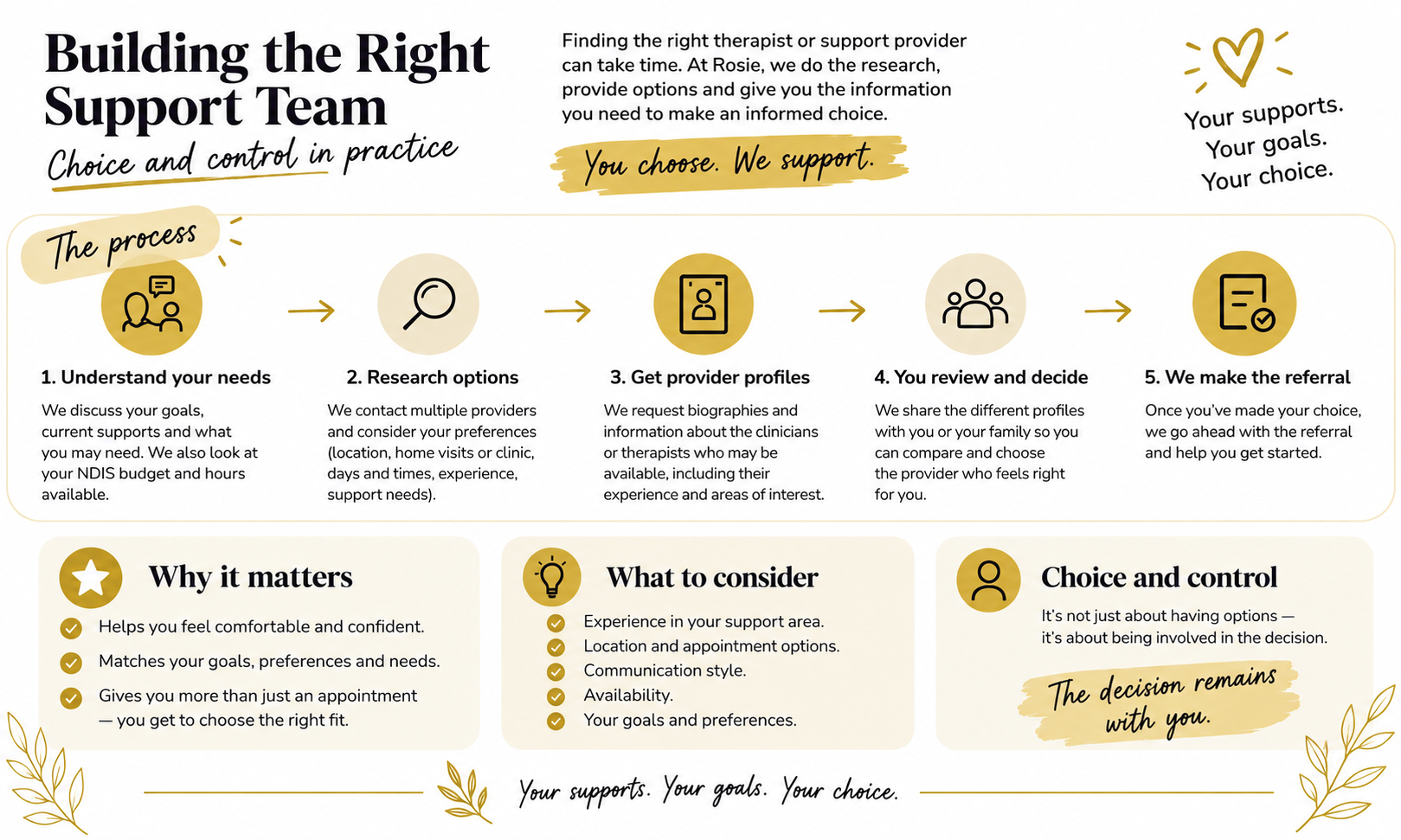
Finding the right therapist or support provider can take time. It can also be difficult to know where to start, especially when you are trying to understand different providers, availability, locations and the type of support that will best suit your needs.
At Rosie Disability Services, we believe participants should have choice and control over who provides their supports.
For us, this means doing the research, providing options and giving participants the information they need to make an informed choice before a referral is made.
It starts with understanding what support is needed
When we first meet with a participant, we discuss their current supports, goals and what additional support they may need.
This could include services such as:
Occupational Therapy
Speech Pathology
Physiotherapy
Psychology
Positive Behaviour Support
Other allied health or disability supports
We also look at the participant's NDIS budget and help break down the available funding so they can understand how many hours of therapy or support may be available.
This can help participants make informed decisions about the type and amount of support they would like to use.
We research the options
Once we know what type of support is needed, we start looking at suitable providers.
For example, if a participant is looking for an Occupational Therapist, we will contact several providers rather than approaching just one.
We consider things that are important to the participant, such as:
Where the provider is located
Whether they offer home visits or clinic appointments
Preferred days and times
The participant's support needs
Relevant experience
Other preferences that are important to the participant
We then provide the provider with information about the participant's disability, support needs and preferences and ask about their availability.
Getting to know the people behind the service
We request biographies or profiles of the clinicians or therapists who may be available to work with the participant.
This can give the participant more information about who they could be working with, including their experience, qualifications and areas of interest.
We share the different profiles with the participant or their family.
They can then take the time to review the options and decide who they would like to work with.
The referral comes after the choice
This gives the participant an opportunity to consider different clinicians and decide who they feel may be the right fit for them.
For example, a participant may prefer an Occupational Therapist who has experience in a particular area. They may prefer someone who provides home visits, works at a particular time, or simply feel that one clinician's profile is a better match for their preferences.
These decisions belong to the participant.
Why does this matter?
Starting with a new therapist or support provider can be a big step.
The participant may be sharing personal information, discussing their goals or working on areas of daily life where they need support. Feeling comfortable with the person providing that support can make a difference to the experience.
There may be several providers who can offer the same type of service, but that doesn't mean they will all be the same fit for the participant.
Having information about the available options allows the participant to make a decision based on more than just who has an appointment available.
The decision remains with the participant.
Your supports. Your goals. Your choice
Want to know more? Enquire below!